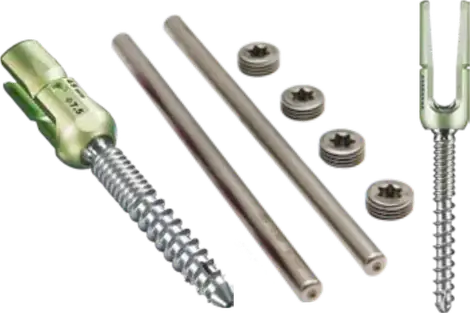

Posterior pedicle fixation · open
Thoracic · lumbar · sacral
Dual-thread polyaxial screws, in reduction and cannulated versions, for single and multilevel constructs as an adjunct to fusion.

Effective solutions to keep your patients moving forward
Ossyn brings together four systems —open pedicle fixation, minimally invasive fixation, vertebral body augmentation and bone cement— on the same titanium alloy and the same instrument logic.
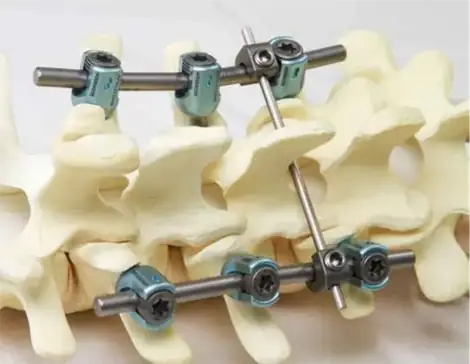
The line
From open multilevel constructs to vertebral compression fractures, with one supplier and shared design principles.
Thoracic · lumbar · sacral
Dual-thread polyaxial screws, in reduction and cannulated versions, for single and multilevel constructs as an adjunct to fusion.
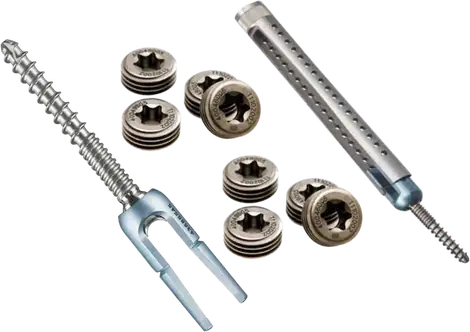

Percutaneous or cortical bone trajectory (CBT)
Cannulated, fenestrated screws with extensions that guide the rod through minimal incisions, with an option for cement augmentation.

T6 – L5
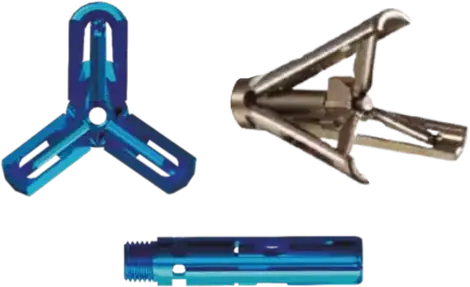
Titanium implant with three-dimensional expansion that restores vertebral body height and remains as structural support.
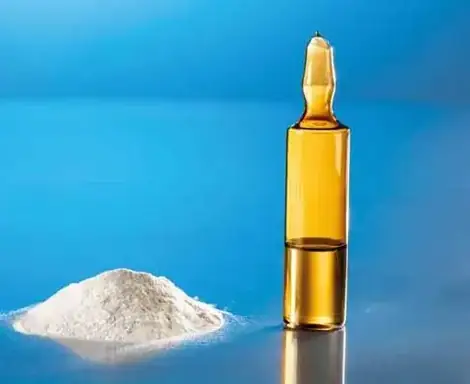

Vertebroplasty and kyphoplasty
Low-exotherm radiopaque cement formulated for vertebral body stabilisation.
By clinical scenario
Explore the spine: each point opens the system indicated for that segment and its clinical scenario.
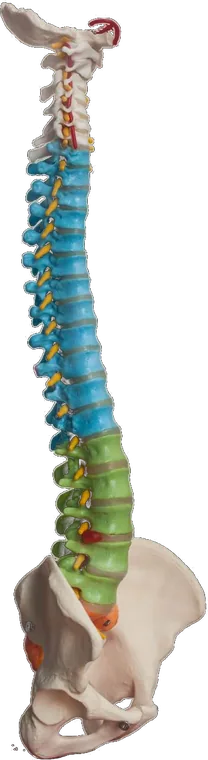 Thoracic · lumbar · sacral
Open posterior pedicle fixation as an adjunct to fusion in degenerative disease, deformity, spondylolisthesis, fractures, tumours and revisions.
View the systemDesign
The design decisions that shape how the implant behaves, shown on the real screw. Switch systems and explore each point.


They extend the head to capture the rod without extra reduction instruments and are removed at the end, leaving a low profile.
Product photography. Features vary by reference; check the technical sheet of each one.
Comparison
The information a technical committee asks for when evaluating the full portfolio.
| Criterion | | | | |
|---|---|---|---|---|
| Type | Posterior pedicle fixation | Minimally invasive fixation | Vertebral body augmentation | PMMA bone cement |
| Approach | Open | Percutaneous or cortical bone trajectory (CBT) | Minimally invasive transpedicular | Through a cement cannula |
| Levels | Thoracic, lumbar and sacral | T6 – L5 | T6 – L5 | Vertebral body |
| Clinical scenarios | Degenerative disease, stenosis, deformity, instability, fractures and tumours | Single-level disease, osteoporotic bone, revisions and adjacent segment | Compression fractures from osteoporosis, trauma or osteolytic lesions | Vertebroplasty and kyphoplasty |
| Range | Screws Ø 4.5 – 6.0 mm · rod Ø 5.5 mm | Screws Ø 5.0 – 7.0 mm · rod Ø 5.5 mm | Two implant sizes | Powder + liquid kit |
| Design feature | Dual thread, self-tapping, tabs with built-in reduction | Cannulated and fenestrated, guided extensions, single-step locking | Controlled three-dimensional expansion; the implant stays | Low exotherm, radiopaque with zirconium dioxide |
| Material | Ti-6Al-4V | Ti-6Al-4V | Ti-6Al-4V ELI | Radiopaque PMMA |
Vertres
Minimally invasive transpedicular approach. The implant expands in a controlled way, restores height and stays as structural support.
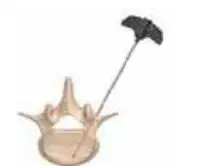
Percutaneous access to the vertebral body under fluoroscopic guidance.
Conceptual illustration. It does not replace the surgical technique or the instructions for use, which are provided to the institution.
The clinical problem
It is the scenario Vertres and Osment address. Fracture morphology determines the technique and the height restoration.
The most common. Height loss concentrates on the anterior wall and pulls alignment into kyphosis.
The endplates give way towards the centre, with the anterior and posterior walls relatively preserved.
Height loss across the whole vertebral body, with the greatest impact on sagittal alignment.
Main causes are osteoporosis, trauma and tumours. In the United States about 750,000 osteoporotic vertebral fractures are estimated each year (The Spine Journal, 2015;15:281–289).
Osment
Cement is where the difference between products shows the most. Osment was formulated around three priorities.
For technical committees
Delivered by e-mail within one business day, in Spanish or English.
Over 60 screw, rod and connector references, with sizes and presentations.
Step-by-step guide for Openped, Unomis and Vertres, with each system’s instruments.
Mechanical tests to ASTM standards, including dynamic construct fatigue (5 million cycles).
Current registration per country and reference, for procurement.
FAQ
Straight answers for surgeons, scrub teams and technical committees.
Ossyn is Maff Health’s spine line. It groups Openped for open pedicle fixation, Unomis for minimally invasive fixation, Vertres for vertebral augmentation and Osment bone cement.
The systems share titanium alloy and design principles, so an institution can cover open, minimally invasive and vertebral augmentation procedures with one supplier.
Cortical bone trajectory (CBT) targets the denser bone of the posterior arch, while the transpedicular technique crosses the pedicle into the vertebral body.
Unomis allows either trajectory with the same screw, whose dual-pitch thread is designed for both cortical and cancellous bone.
The implant deploys in a controlled way inside the vertebral body to restore its height, and remains there as structural support while the cement spreads around it.
In balloon techniques the device is removed at the end and support relies on the cement alone.
Yes. Cannulated and fenestrated versions allow cement augmentation, useful in osteoporotic bone.
Indication and technique are at the surgeon’s discretion and follow the system’s instructions for use.
Cement polymerisation releases heat. A lower setting temperature reduces thermal exposure of the surrounding bone tissue.
Osment is formulated for low exotherm with zirconium dioxide as radiopacifier for visualisation during the procedure.
Yes. Surgical technique, reference catalogue and test summary are delivered to institutions and distributors, in Spanish and English.
Request them through the contact form stating your institution and country.
Contact
Tell us your country, the line you are interested in and the patients you serve. We reply with the right reference, presentation and terms within 24 to 48 business hours.
To report an adverse event or a product complaint, choose that reason in the form. Those reports are handled with priority by the quality team.